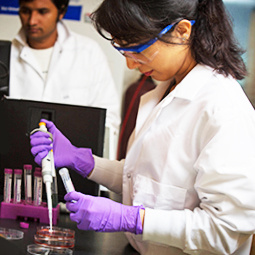
Megha Singh grew up in what is known as the “Food Bowl of India.” The agrarian community in Punjab
introduced the environmental health sciences (ENHS) doctoral student to farming from a very young age.
Growing up, she often visited her grandparents’ home, spending time in their vegetable
garden and experiencing the lush green agricultural fields that were part of the surrounding
landscape. Singh also observed them using manure and, occasionally, fertilizers to
help improve the garden’s yield. Her grandparents shared stories about how farming
was practiced in their time, on a smaller scale and with largely manual labor.
In my graduate programs, I’ve discovered the joy of science, process of asking questions,
working in the lab, running experiments, and trying to understand problems facing
the natural world.
Megha Singh
“Watching my grandparents cultivate their vegetable garden, and seeing others work
the fields naturally sparked many questions in me, like why fertilizers were added
and what was in the soil that could turn a tiny seed into a thriving crop,” Singh
says. “While witnessing traditional farming practices answered some of these questions,
I became increasingly curious about the science behind them, particularly what was
happening in the soil that we could not see.”
When it was time to attend college at Punjab Agricultural University, studying agriculture
was a natural fit for Singh, and she began to understand the science behind soil and
food production, how agricultural practices influence the food we eat, and how they
shape the memories and ways of life that stay with communities across generations.
Singh followed that degree with a master’s in soil science from the University of
Wyoming, where her research focused on soil health in high-elevation, flood-irrigated
meadows. She then immediately enrolled in the Arnold School’s Ph.D. in ENHS program.
“In my graduate programs, I’ve discovered the joy of science, process of asking questions,
working in the lab, running experiments, and trying to understand problems facing
the natural world,” Singh says. “I have found myself deeply engaged in lab and field
work, especially as I began to see how the questions we study connect to problems
beyond the laboratory.”
Megha Singh is a student in the Ph.D. in Environmental Health Sciences program.
Singh’s decision to attend USC was driven by the approachable and generous ENHS faculty,
particularly the opportunity to work with assistant professor Andi Jilling. With shared interests in understanding the connections between soil, agriculture,
and environmental health, the two have been conducting research together in Jilling’s
Environmental Soil Science Lab since Singh’s arrival in 2024.
“Dr. Jilling is a knowledgeable, supportive, and compassionate advisor who has always
encouraged me to grow not only in my research project but also as a scientist and
as a person,” the Norman J. Arnold Doctoral Fellow says. “She gives me the freedom
to explore my ideas, ask questions, and learn through the process, while always being
there to provide guidance when I need it.”
Singh credits Jilling’s support and guidance for helping her achieve the most recent
milestone in her career: securing a Bayer Fellowship to support a three-month research
experience. From encouraging her to pursue the opportunity to helping her develop
her research proposal to connecting her with professors in Germany, Singh’s mentor
has been with her every step of the way.
“Thanks to this support from the Bayer Foundation, I will join Dr. Steffen Schweizer’s
lab at the Technical University of Munich, where I will receive training in NanoSIMS,
an advanced analytical technique for studying soil processes at nano-scales,” Singh
says. “Germany has a long-standing reputation as a ‘land of thinkers and innovators,’
and many important agricultural advancements have come from there, which makes me
especially excited about this opportunity. I believe this experience will strengthen
my research skills, broaden my perspective, and help me grow toward becoming an independent
researcher.”
With interests in the composition and behavior of two distinct soil organic matter
pools – particulate organic matter, made up of partially broken-down plant material,
and mineral-associated organic matter, which is bound to soil minerals – her research
focuses on how mineral-associated organic matter regulates nitrogen availability to
plants and microbes. Although this mineral-bound pool holds a substantial amount of
soil nitrogen, most of it is not accessible. Through her doctoral training, Singh
hopes to better understand the processes that make this nitrogen available to reduce
reliance on mineral fertilizers and apply that knowledge to support soil health and
more efficient nitrogen management throughout her career.
When thinking about her long-term goals, she returns to Nobel Peace Prize laureate
and agricultural scientist Norman Borlaug’s proclamation that ‘food is the moral right
of all who are born into this world.’
“Through pursuing a career in soil science, I hope to contribute to this vision and
be part of the next agricultural revolution – one that meets the food demands of a
growing population while sustainably managing our natural resources,” Singh says.